Project in collaboration with the nature reserve of the Bay of Saint-Brieuc
Photographic exhibition by Stéphanie Pommeret

Exhibition presented at :
BIENALSUR, Contemporary Art Biennial in South America, 2019, August 2023, and May 2024
- Centro Cultural El Parque de España, in Rosario
- Centro Cultural Banco do Brasil in Brasilia, São Paulo and Rio de Janeiro
Supported notably by UNESCO, the Fundacion Foro del Sur and UNTREF Universidad Nacional de Tres de Febrero.
- La Passerelle, national stage of Saint-Brieuc
- RÉSIA (Armor International Solidarity Education Network)
- Le Grand Pré, cultural center of Langueux
- Le Dôme, cultural center of Saint-Avé
- L’Image Qui Parle in Paimpol
Migrating is etymologically "going from one place to another", whether for a period journey that always returns to the starting point, or a journey without return. And the human species, like all its sisters, has never stopped stirring, moving, traveling, migrating, throughout its history since its African origin almost 2 million years ago. The first humans migrated for multiple reasons, such as climate change, food supply or maybe just to discover new horizons… Whatever the motivations, because since the origin of life on earth, we are all migrants. Thus "the Neanderthals and Homo sapiens who arrived in Europe were migrants and mixed together to make us original mestizos. » wrote Edgar Morin.
Whether one is an emigrant on one side of the border or an immigrant on the other, none of this really makes sense. Migrations are not only essential for the survival of the individual but also for the maintenance of the species in the long term. Because a species that can no longer move, which is geographically limited - we then speak of endemism - is strongly threatened by the slightest change in living conditions on the site, and risks disappearing very quickly. Doesn't one of the riches of the bay of Saint-Brieuc come from its birds which have emigrated from the Nordic countries to immigrate to Brittany ?
Alain Ponsero
Warden
Director of the Saint-Brieuc Bay Nature Reserve
Migration !
Migration ! The term speaks of birds as well as humans. We go from one place to another. From one country to another. For the birds it is not a journey without return, on the contrary it is a cycle. For humans, the return is not always the cycle of travel, but it can be. Voluntary or forced. People migrate to feed their families, to find work or study, to flee a dictatorship or a system of oppression. Leaving for love, arriving for desire. Faced with war, too, a climate crisis or an intolerant society. For birds it is the climate that is the motor, and the cycle of life. As in the bay of Saint-Brieuc where the birds come from the far north. For humans, it is the imbalance between nations that triggers departure.
But migration is never neutral, it speaks to us of welcome, of rupture, of integration, of culture, of identity too and, ultimately, of acceptance. It is a complex process, where it takes two – the one who welcomes and the one who arrives – for the process to work. Migration is never superficial, it is a major act, which speaks of uprooting and integration. She tells us about life. We watch the birds pass, we are just beginning to watch the humans coming.
Pascal Blanchard
historian
associate researcher at the CRHIM in Lausanne
Bringing together ecology, nature preservation and art allows a dialogue of ideas that go beyond cultures. These worlds have to be brought together, and thus open up the field of possibilities to activate a new imaginary of collaboration. I place the encounter at the heart of my practice. Discovering the world of the other, seeing their knowledge, feeling their sensitivity triggers a new look at my horizon. Let's walk, take the time to see. Birds shed a unique light on ourselves.
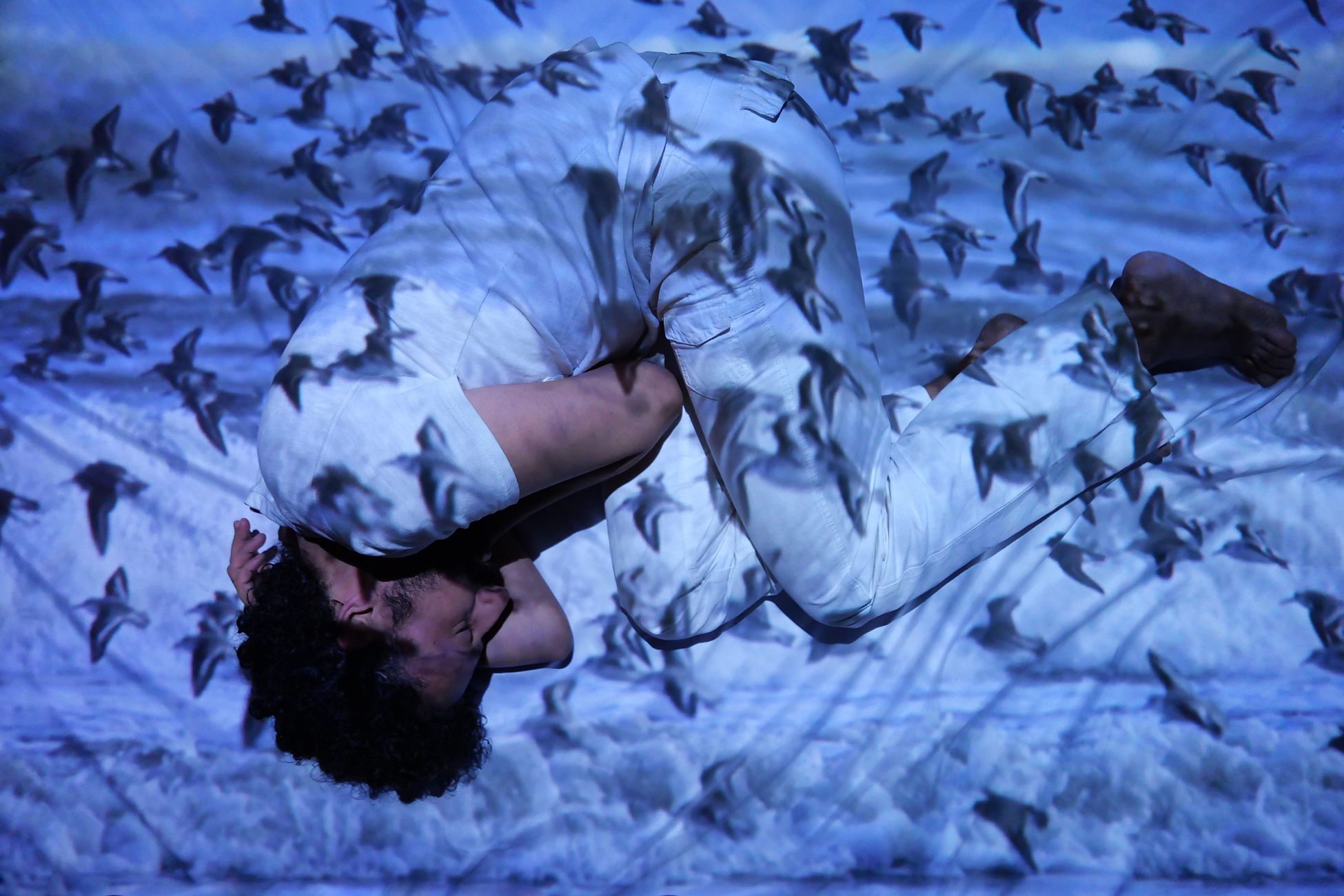
This project, with the nature reserve of the bay of Saint-Brieuc, enriches my creation. Alain Ponsero's photographs are the result of long and passionate observation. These naturalist photographs, I mix them with my artistic gaze. Like a sample in music, I reappropriate these photographs, and seek to reveal a poetic vision.
Stéphanie Pommeret