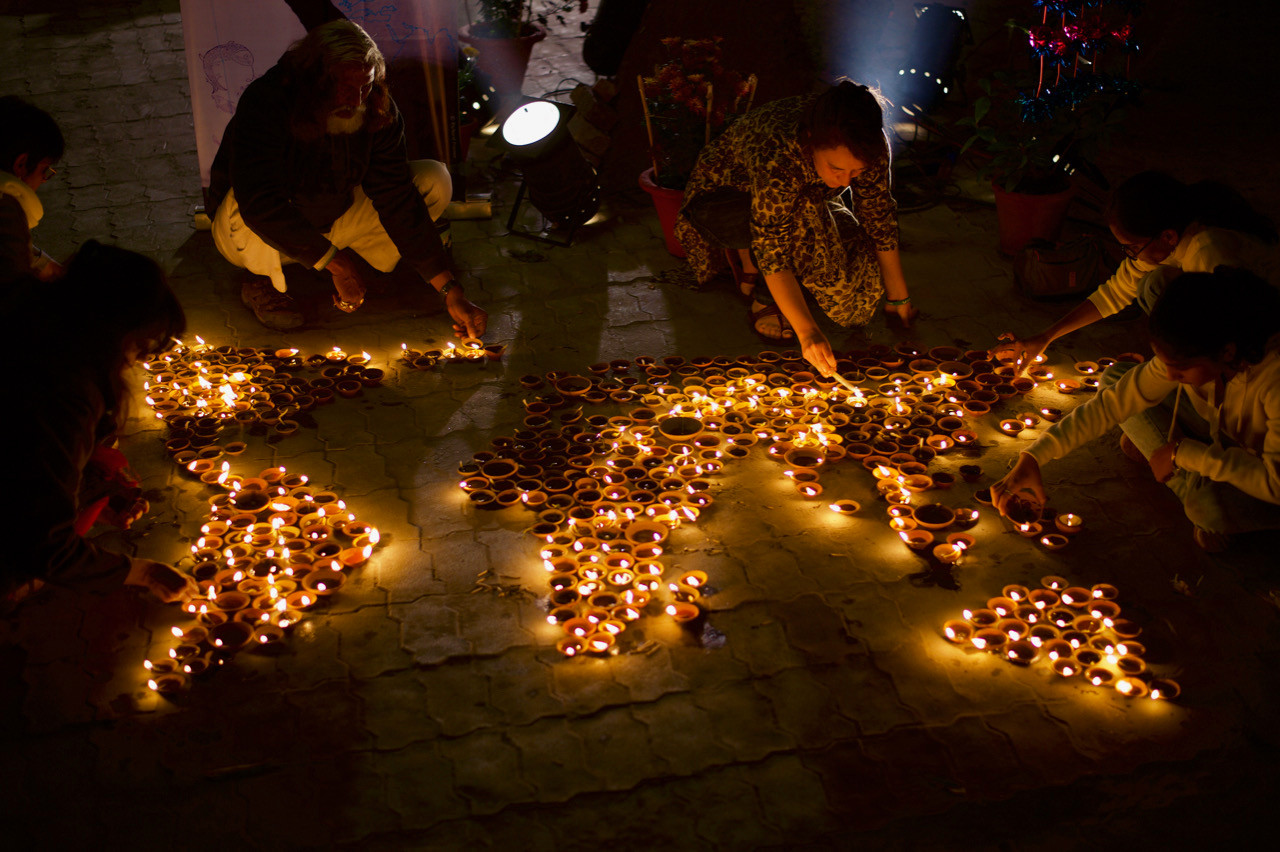
My artistic approach
For the cartographers of the past, producing a map was the work of a lifetime. Today, I consider each map to be a work of art.
I fully share Jean-Claude Groshens’ view when he writes in the catalogue of the exhibition Cartes et figures de la Terre (Centre Georges Pompidou, 1980):
"Cartography thrives on this kind of ambiguity that places it at the confluence of exact science and art. Based on physical description and mathematical theory, it necessarily rediscovers at one moment or another in its history, this kind of wager that reintroduces the imaginary into theoretical principles and makes the map a representation."
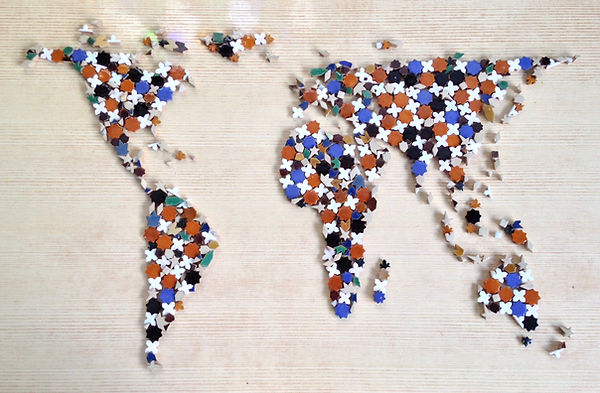
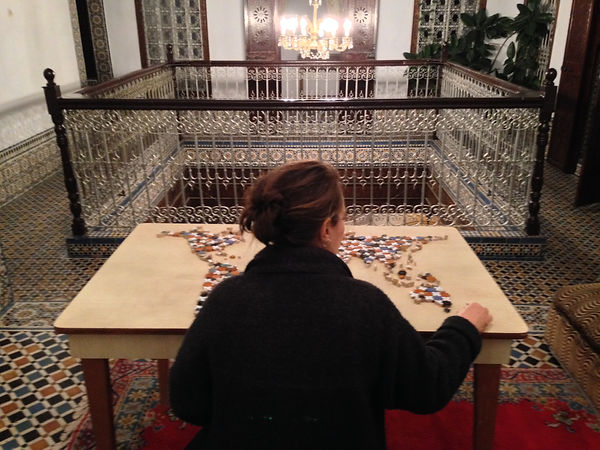
My approach consists of reusing scientific projections of the world to propose a global vision, without borders, as one unified whole. Through my artist residencies, I collaborate with local craftspeople, appropriating their know-how and poetry derived from ancestral practices. This encounter between scientific rigor, contemporary vision and traditional techniques gives birth to new sensitive cartographies.
Zardozi Map made in India in Lucknow
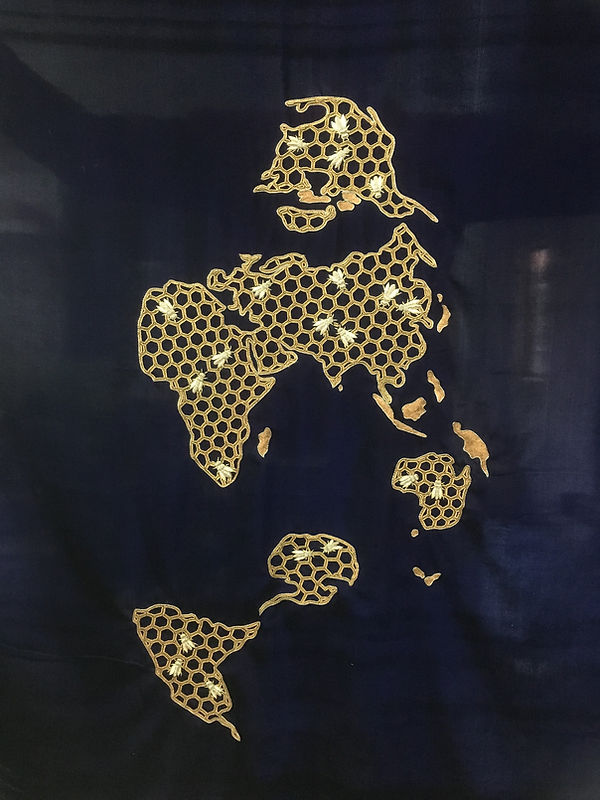
This world map was embroidered by craftspeople from Lucknow using the Zardozi technique ("gold work" in Persian), employing golden and silver threads.
I chose a Chinese projection that places India at the center, decentering Europe and offering an alternative vision of the world.
The embroidered bees symbolize harmonious organization and echo the current ecological crisis: their disappearance would threaten all of humanity.